
Outdoor Fire Pit Installation in Washington: Gas vs. Wood, Safety, and Building a Space You Actually Use

There is a reason the fire pit is the feature homeowners ask us about most once the patio is done. It is the part of the yard people actually gather around. In our climate, where evenings cool off fast and the outdoor season feels short, a fire pit installation is the single upgrade that gets the most use for the longest stretch of the year. It pulls people outside in spring, holds the patio together all summer, and keeps it usable well into the gray months when everyone else has gone indoors.
But "a fire pit" covers everything from a $200 steel bowl from the hardware store to a custom built-in paver feature wrapped in seat walls. The right choice depends on how you want to use the space, how much maintenance you want, and a set of Washington-specific rules that catch a lot of homeowners by surprise. At Kairos Landscapes, we design and build fire features as part of a complete outdoor living space, and the first conversation is always the same two questions: gas or wood, and how do you actually want to use it. This guide walks through both, plus the safety and code details that matter here in the Puget Sound region.
TL;DR: Outdoor Fire Pit Installation in Washington
The first decision is gas versus wood. Gas fire pits are cleaner, instant, low-maintenance, and far less likely to be shut down by air-quality burn bans, which makes them the easier choice in our region. Wood-burning pits deliver the crackle, heat, and ambiance some people will not give up, but they produce smoke, require more upkeep, and are restricted more often.
Either way, Washington homeowners need to know the rules: the Puget Sound Clean Air Agency limits recreational fires and issues burn bans, and fire pits should sit a safe distance from structures on a non-combustible base. A professionally built, permanent paver fire pit, integrated with seating and your patio, is what turns a fire feature from an occasional novelty into the center of your backyard.
Also Read
Picturing evenings around the fire? Let's design a fire feature that fits your patio, your style, and Washington's rules. Request a free estimate from Kairos Landscapes and we'll map it out with you.
Key Points
Gas is the low-friction choice. Instant on, no smoke, minimal cleanup, and usually exempt from air-quality burn bans that shut down wood fires.
Wood delivers ambiance and heat. The crackle and warmth are unmatched, but expect smoke, ash, more maintenance, and more frequent restrictions.
Puget Sound has real rules. Recreational wood fires must be small, set back from structures, and burn only seasoned wood, and they are banned outright during air-quality burn bans.
Burn bans are seasonal and predictable. Air-quality bans hit in fall and winter; fire-safety bans hit in dry summer months. Gas features sidestep most of this.
The base must be non-combustible. Fire pits belong on pavers, gravel, or concrete, never directly on a wood or composite deck.
A built-in fire pit beats a portable one. Integrated with seat walls and your patio, it becomes permanent usable square footage instead of a bowl you store in the garage.
Placement is a design decision. Setbacks, wind, seating flow, and gas-line routing all need to be planned before construction starts.

Gas vs. Wood: The Decision That Shapes Everything
Almost every fire pit project starts here, and the honest answer is that both are good options for different people. Here is how they actually compare.
The Case for Gas
Gas fire pits win on convenience and compliance. As Firegear Outdoors lays out, gas gives you a steady flame at the turn of a knob with no kindling, no tending, and no waiting. Gas burns cleaner with minimal emissions, which matters in tighter neighborhoods, and there is essentially no cleanup, since you simply turn it off and walk away.
The compliance angle is the one Washington homeowners underrate. Because gas features produce no smoke or embers, they are typically exempt from the air-quality burn bans and no-burn days that shut down wood fires for weeks at a time. In a region that calls bans regularly, that is the difference between a feature you can use whenever you want and one that sits cold during the very evenings you most want it. The tradeoffs are real but manageable: more components that can eventually need service, and a connection to your gas line or propane supply.
The Case for Wood
Wood-burning pits keep the experience some people simply will not trade away. They burn hotter than gas, fill the space with that unmistakable crackle and aroma, and let you cook over an open flame. For a lot of homeowners, that is the whole point of a fire.
The downsides are equally real. Wood produces smoke that irritates eyes and lungs and clings to clothes and hair, plus sparks and embers that are a genuine hazard in dry conditions. There is ash to clean and wood to store and haul. And wood pits are the ones most affected by local restrictions. If you love a real fire and have the space to use one responsibly, wood is a wonderful choice. If you want something you can light on a whim year-round with zero fuss, gas is the smarter call in our climate.
What Washington's Fire Rules Actually Require
This is the section most fire-pit articles skip, and it is the one that matters most here. In the central Puget Sound region, the Puget Sound Clean Air Agency regulates outdoor burning across King, Kitsap, Pierce, and Snohomish counties, which includes Maple Valley and the communities we serve.
Under those rules, recreational fires, which include fire pits and similar free-standing devices, must generally be less than 3 feet in diameter and less than 2 feet high, kept at least 50 feet from any structure, and burn only seasoned wood, never trash. And critically, the smoke must not create a nuisance for your neighbors, which the agency takes seriously enough that smoking out a neighbor is itself a violation.
On top of that, two kinds of burn bans apply. Air-quality burn bans are issued by the Clean Air Agency when pollution levels climb, typically in the colder fall and winter months, and recreational wood fires are always prohibited during them. Separately, fire-safety burn bans are called by fire marshals during dry summer conditions to reduce wildfire risk and can last for months. Between the two, a wood fire pit can be off-limits for big stretches of the year. Gas features generally remain usable through air-quality bans, which is a major reason we steer many clients toward gas. Before any installation, it is worth confirming current rules with your local fire district, since requirements vary by jurisdiction.
Safety Fundamentals for Any Fire Pit
Regardless of fuel, a few safety basics are non-negotiable, and they shape where and how we build.
The base must be non-combustible. A fire pit belongs on pavers, gravel, or concrete, and a wood-burning pit should never sit directly on a wood, composite, or vinyl deck without a proper non-combustible base or high-temperature mat extending well past the pit, per general guidance compiled in this fire pit safety overview.
Setback distance matters too; even beyond the agency's structure rules, keeping clearance from fences, eaves, low branches, and seating prevents the most common backyard fire accidents. And placement should account for prevailing wind so smoke and heat move away from where people sit, not into it. These are exactly the details that get planned correctly when a fire feature is built into the landscape rather than dropped onto it.
Want a fire feature that's safe, compliant, and genuinely built in? See how we integrate fire pits with patios and seat walls on the Kairos fire pits and seat walls page, then let's talk about your yard.

Why a Built-In Paver Fire Pit Outperforms a Portable One
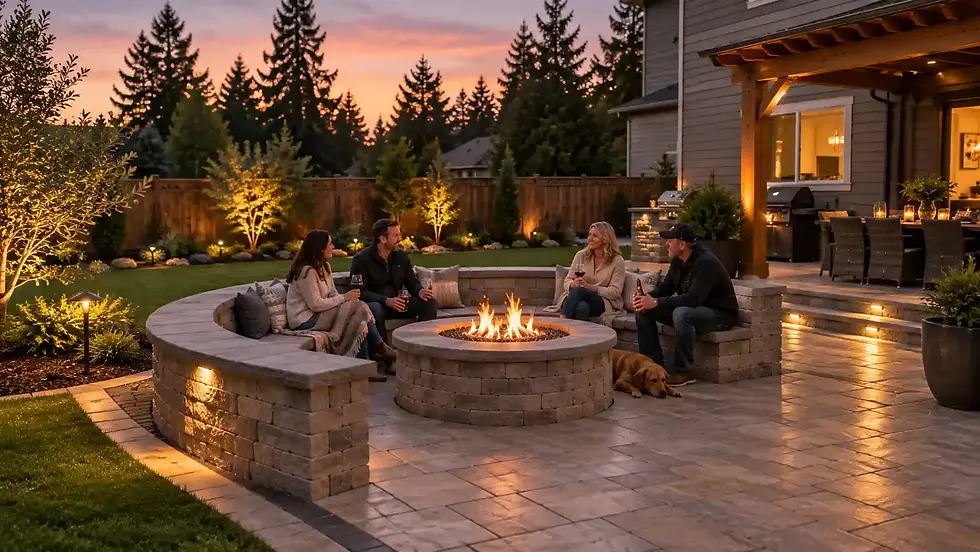
A portable fire bowl has its place, but it never becomes part of the yard. A built-in paver fire pit does. When we design a fire feature, we treat it as the anchor of an outdoor room: a permanent pit sized and placed for your space, ringed by seat walls that add built-in seating and define the area, set into or alongside a paver patio so the whole space flows together. The result is usable square footage you reach for constantly, not a bowl you wheel out and store away.
Built-in features also let us solve the fuel, drainage, and safety questions properly. Gas lines get routed and concealed during construction. The base is engineered to be level, stable, and non-combustible. Seat walls double as wind buffers and traffic guides. And because it is built from the same paver and stone materials as the rest of your hardscape, it looks intentional rather than added-on.
This is the kind of integrated work that benefits from a specialist; as Belgard-authorized and CMHA-certified installers building with in-house crews since 2013, fitting a fire feature seamlessly into a larger outdoor living plan is exactly what we do.
Designing Around How You'll Use It
The best fire pit projects start with use, not product. Are you hosting big groups or having quiet evenings for two? Does it need to coordinate with an existing patio or anchor a brand-new one? Gas for year-round convenience or wood for the full experience? Those answers drive the size, the placement, the seating, and the fuel, which is why we walk the space with every client before we design anything.
The Bottom Line on Fire Pit Installation in Washington
A fire pit is the feature that earns its keep, because it is the one that extends your outdoor season and pulls people together. In our region, gas is the easy, year-round, burn-ban-resistant choice, while wood rewards those who want the full sensory experience and have the space to use it safely.
Either way, the value comes from building it right: compliant with Puget Sound's rules, safe in its base and placement, and integrated into your patio and seating rather than parked on top of it. Plan it as part of your outdoor living space, and the fire pit becomes the spot where your backyard actually gets used.
Let's build the spot everyone gathers around. Kairos Landscapes designs and installs custom paver fire pits and seat walls built for Washington, by in-house crews, backed by our 15-year warranty. Request a free estimate and let's plan your space.



Comments