
Landscape Lighting Installation: Designing for a Dark Northwest Winter
Count the hours honestly. From early November through mid-February, most of us leave for work before the sky lightens and pull back into the driveway well after it goes dark again. The patio that cost real money in July becomes a black rectangle outside the kitchen window. In the rain, carrying groceries, you navigate the front walk by memory.
This season makes the case for landscape lighting better than any summer evening could. Done well, it does three jobs at once: makes walkways and stairs safer when they're wet, keeps the hardscaping you paid for visible through the eight months you'd otherwise forget it exists, and gives the house a finished look from the street. Done badly, it produces glare, annoys the neighbors, and corrodes into failure by the second winter. At Kairos Landscapes, we've built outdoor spaces across the Puget Sound since 2013, and lighting is the single upgrade that changes how often you use your yard.
Also Read
The Two-Minute Version
A professionally installed landscape lighting system runs about $3,250 nationally, with most projects between $2,000 and $4,500 and simple setups starting near $500, per LawnStarter's 2026 cost data. Individual installed fixtures run $100 to $200, and labor runs $45 to $100 per hour. The design matters more than the fixtures. A good installer walks the property after dark, figures out what the light should accomplish in each zone, and then layers three kinds of fixtures to do it: path lighting for safe footing, uplighting for trees and architecture, and wash or grazing light for walls and textures.
The system runs on low voltage through a transformer. The crew buries the wire, and the connections must survive standing water because, in this climate, they will sit in it. Warm color temperature keeps the house looking like a home instead of a parking lot. The installer aims fixtures down and shields them so the light lands on your property rather than in your neighbor's bedroom. Expect a site walk, a written plan with fixture counts and placement, and a crew that returns to re-aim everything once the plants fill in.
Why Lighting Matters More Here Than Almost Anywhere
Most landscape lighting content targets places with long, dry evenings, where lighting extends a summer dinner party. The Western Washington case is different and frankly stronger.
Start with the daylight. At this latitude, late December gives us a little over eight hours between sunrise and sunset, and overcast conditions cut the useful light at both ends. For roughly a third of the year, you see your own landscaping only if you light it.
Then there's the wet. Mossy pavers, slick stair treads, and a walkway that drains toward the front door are ordinary conditions here from October through May. Those are exactly the surfaces where someone misjudges a step in the dark. In that context, path and step lighting isn't decorative; it's the difference between a fall and an uneventful walk to the car.
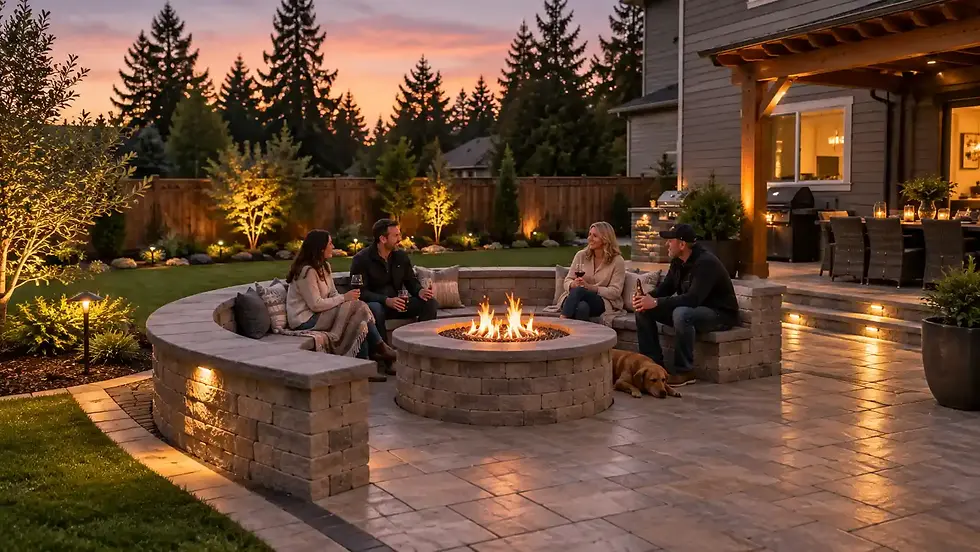
Lighting also protects the money already in the ground. A paver patio, a seat wall, a specimen Japanese maple, a well-built set of stone steps: these investments disappear at 4:30 in the afternoon for most of the year unless something lights them. Two-thirds of outdoor lounge areas now include lighting, per Houzz's 2026 outdoor trends report.
The Three Layers That Make a Plan, Not a Row of Lights
The most common DIY mistake: buying a kit of eight identical path lights and spacing them evenly down a walkway like runway markers. It lights the ground and nothing else, and it looks exactly as mechanical as it sounds.
Real landscape lighting design works in layers.
Functional light comes first. Path lights, step lights set into risers, and discreet fixtures tucked under seat-wall caps handle the places where people walk, step up, or step down. Place them where the geometry demands, not at tidy intervals.
Accent light gives the yard depth. Uplights at the base of a mature fir or a multi-stem maple turn a dark mass into a focal point. A fixture aimed up a stone column or across a retaining wall highlights the material's texture. Homeowners notice this layer from inside the house, through the window, on a January evening.
Ambient light fills in. Think a soft wash on the house facade, downlighting from a pergola or a tree branch to mimic moonlight across a patio, and a low glow along a planting bed. It keeps the composition from reading as a series of bright spots floating in black.
Restraint matters most. A property where every tree is uplit at full brightness looks like a car dealership. Aim for contrast, with dark space between the lit elements.

What Low Voltage Means for Your System
Nearly all residential landscape lighting installation today runs on a low-voltage system. A transformer steps down household current, and that lower-voltage power runs through buried cable to the fixtures.
Two things follow from that, and both matter in this climate. First, the system is safer and simpler to modify, so a well-designed layout expands later when you add a patio or take out a tree. Second, and more important here, the weak point is never the fixture. It is the connection. Wire splices sitting in saturated soil for eight months a year corrode if someone used the wrong connectors, and a corroded splice takes out everything downstream. The failures we get called out for are almost always buried connections and undersized wire runs, not dead lamps. The lamps themselves last: LEDs run 25,000 to 40,000 hours, compared with up to 3,600 hours for halogen.
Ask any outdoor lighting contractor you're considering how they make and protect their connections, what wire gauge they use, and how they size the transformer for the load. A good one answers immediately and in detail, and leaves headroom on the transformer for future additions.
Color Temperature, Brightness, and Not Annoying the Neighbors
Two settings determine whether the result looks warm and intentional or harsh and industrial.
Color temperature comes first. Warmer light around 2700K reads like lamplight and flatters stone, wood, and foliage. Lighting designers interviewed by WBUR recommend staying at 2700K or below outdoors, and suggest starting around 400 to 800 lumens for residential fixtures. Push up toward the bluish 4000K and 5000K range sold as "daylight," and a home exterior starts to look like a loading dock.
Brightness comes second, and more is almost always worse. Fixtures throwing thousands of lumens belong on commercial sites. Residential path and accent lighting works at a small fraction of that, and the eye adapts to darkness far better than most people expect.
Aim and shielding tie it together. DarkSky International and the Illuminating Engineering Society jointly publish five principles for responsible outdoor lighting. The practical version for a homeowner is short: light only what needs lighting, point the fixture down, shield it so the source isn't visible from the street or a neighbor's window, keep it no brighter than the task requires, and put it on a timer or control so it isn't burning at three in the morning. A thoughtful installer designs for this by default, and the result looks better, not more restrained.
The Landscape Lighting Installation Process, Stage by Stage
A professional landscape lighting project moves through recognizable stages.
It starts with an evening site walk. Daylight hides the problem you're trying to solve. Walking the property after dark is how you find the step that disappears, the corner that feels unsafe, and the tree worth lighting.
Next comes a plan on paper: fixture types and counts, placement, transformer location and size, wire runs. You should see what you're buying before anyone digs.
Installation itself goes quickly compared with hardscaping, often one to two days for a typical residential system. Crews trench the cable in rather than laying it on the surface, set the fixtures, and mount the transformer on a GFCI-protected circuit.
Then comes the part that separates good work from average: night aiming. Someone adjusts every fixture after dark, on site, standing where you'll stand. A system nobody night-aimed is obvious from the street.
Finally, a reputable installer tells you to expect a return visit. Plants grow. An uplight perfectly aimed at a young maple shoots into the canopy three years later.

Vetting a Landscape Lighting Installer in Washington
Before you sign anything, confirm the contractor is registered, bonded, and insured through the Washington State Department of Labor and Industries verification tool. It takes under a minute and tells you whether the registration is active and whether any claims are unresolved.
Beyond that, ask to see night photographs of completed work rather than daytime shots of fixtures. Ask who performs the installation, because a crew on your own payroll behaves differently from a sub hired for the week. Ask what happens in year three when a connection fails or a plant outgrows its light, and get the answer in writing. Our installations carry a 15-year warranty, and we run in-house crews rather than subcontractors.
If you're weighing lighting alongside other work, schedule it in the same project. Running cable before a patio goes down, or while a retaining wall is still open, is dramatically easier than retrofitting around finished hardscape.
Ready to See Your Yard After Dark
If you've spent money on an outdoor space you look at only from June through September, lighting is the upgrade that gives you the rest of the year back. Kairos Landscapes provides landscape lighting services throughout Maple Valley, Covington, Issaquah, Renton, and the surrounding Puget Sound communities. We design the lighting system and install it ourselves, as part of a full outdoor living build or as a standalone project.



Comments