
How to Choose the Best Paver Patio Contractor in Washington for a Backyard That Lasts

Hiring a paver patio contractor is a bigger decision than most Washington homeowners realize. The patio you build this year shapes how your family uses the backyard for the next two decades, from summer dinners with neighbors to early mornings under a covered seat wall with a cup of coffee. The hard part is that the gap between a careful installer and a rushed one rarely shows up on day one. It shows up two winters later when the surface starts shifting, joints start gapping, and water starts pooling in the wrong places.
The good news is that most of the warning signs are visible before you ever sign a contract. At Kairos Landscapes, we work with homeowners across the Puget Sound on these exact decisions, helping them invest in a backyard that holds its shape, drains correctly, and still looks the way they imagined the day the last paver was set.
Also Read
TL;DR: Hiring a Paver Patio Contractor in Washington
Choosing the right paver patio contractor comes down to three things: proper base preparation, current installation standards, and a design that fits how your family actually lives outdoors. A Washington contractor registered with Labor and Industries, carrying the right bond and insurance, holding industry certifications, and showing finished work in your area is the safest bet for a patio that stays beautiful for decades. The rest of this guide walks through what to look for, what to ask, where projects most often go wrong, and how to budget for a build that returns real value at resale.
Considering a paver patio for your backyard? Walk through your space, your budget, and your timeline with a team that builds patios for the long run. Request a free estimate from Kairos Landscapes when you are ready to talk specifics.
Key Points
Base prep is the project. Most paver failures are base failures, not material failures. A great contractor over-engineers the foundation.
Drainage planning matters more than pattern. Where the water goes shapes how long the patio lasts in the rainy Pacific Northwest climate.
Verify Washington credentials. Always confirm Labor and Industries registration, bonding, and current general liability insurance before signing.
Certifications are not just letters. Industry credentials like NCMA and ICPI signal that the crew has been trained on current installation standards.
Material source matters. Big-box pavers and contractor-grade pavers are not the same product. The difference shows up in fade, freeze-thaw cracking, and edge chipping.
A bid is not a contract. A real proposal includes scope, base depth, edge restraint type, joint stabilization, drainage plan, and warranty terms in writing.
ROI is real, but only when the work is done right. A well-built paver patio recovers a large share of its cost at resale and is one of the highest-rated home projects for owner satisfaction.
Local design experience pays off. A contractor who has worked across King and Pierce counties knows the soils, slopes, and microclimates that shape the build.

Why a Paver Patio Is Worth the Investment for Washington Homes
Outdoor living is no longer a seasonal indulgence in the Puget Sound region. Homeowners are spending more on backyard upgrades than ever, and the projects that hold up best at resale tend to be the ones that look permanent and live easily. System Pavers reports that 77 percent of homeowners are planning a backyard upgrade in 2026, with landscaping and outdoor seating ranked as the top two priorities. That demand has been pushing patio projects from a nice-to-have to a core part of how families plan their property.
The financial story holds up too. According to HomeLight's analysis of paver patio value, a freestanding paver patio can return between 20 and 30 percent of its cost at resale, while a patio added directly off the home at an entryway can return up to 80 percent. Angi's 2026 cost research puts most paver patio projects between $4,000 and $16,000 depending on size, material grade, and site conditions. The catch is that the upper end of that ROI range only shows up on patios that were built well the first time.
What Pavers Offer That Concrete Slabs Cannot
Concrete slabs are the default suburban patio for a reason. They are fast, they are cheap, and they look fine for a few seasons. The problem is what happens next. Concrete is a single rigid plane, and freeze-thaw cycles in Washington split it along stress lines that no homeowner can hide. Once a slab cracks, the only fix is removal and replacement.
Pavers are a flexible system. Each unit moves a fraction of a millimeter against the next, which lets the surface absorb temperature swings and minor settlement without showing damage. When something does go wrong, a single paver can be lifted and reset without redoing the whole patio. For Washington homes that see real freeze-thaw exposure plus heavy fall and spring rain, that flexibility is the difference between a patio that ages well and one that becomes a tear-out project at year seven.
How a Patio Changes the Way You Use the Backyard
A well-designed patio extends your usable square footage in a way few other projects can match. Builder Magazine's 2026 outdoor living forecast identifies multi-functional zones as one of the defining trends of the year, with families wanting flexible outdoor spaces that handle dinner parties, kids' birthdays, weekend cooking, and quiet evenings on the same footprint. A thoughtfully zoned paver patio can carry all of that.
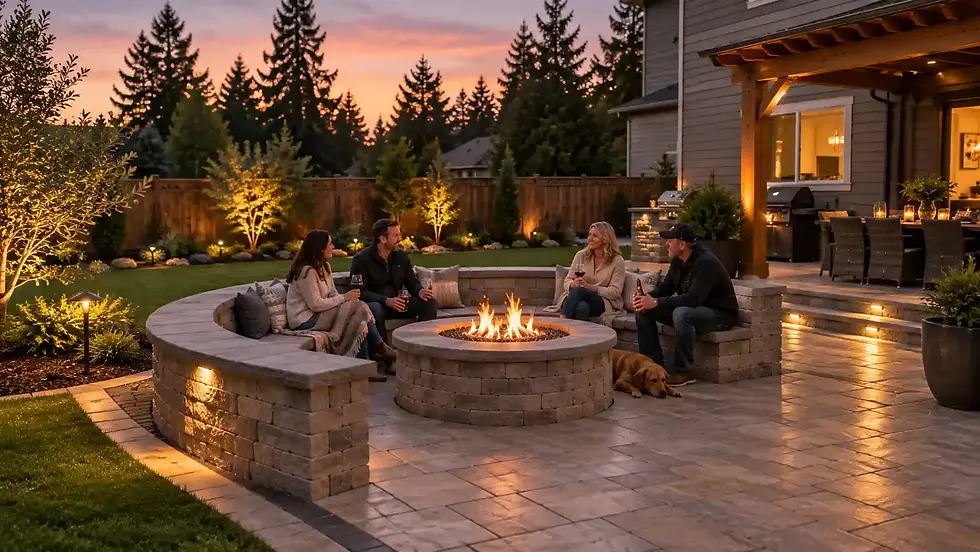
Most Kairos clients pair their patio build with at least one adjacent feature, like a fire pit and seat wall combination or a low retaining wall that doubles as a planting bed. That kind of integrated design is what separates a forgettable patio from one that becomes the most-used room in the house.
What Separates a Great Paver Patio Contractor From an Average One
On the surface, every paver patio contractor will tell you they prep the base correctly, install to manufacturer specs, and stand behind their work. The reality is that quality varies enormously across the Washington market. The first place to look is paperwork. Every legitimate contractor in the state must register with the Department of Labor and Industries, carry a continuous surety bond, and hold either $200,000 of public liability and $50,000 of property damage coverage or $250,000 in combined single-limit insurance. If a contractor cannot give you their L&I number on the spot, the conversation should end there.
Beyond the legal floor, look at credentials and material partnerships. A contractor who has invested in NCMA certification for hardscape and segmental wall installation has been tested on current best practices. A contractor recognized as an authorized installer by a major paver manufacturer has been vetted on volume, training, and warranty performance. Those signals do not guarantee perfection, but they consistently filter out the bottom of the market.
The Material Question
There is a real difference between pavers sold at big-box stores and pavers sold through dedicated landscape suppliers. Manufacturer specifications matter. The Interlocking Concrete Pavement Institute installation manual references ASTM C936, which requires a minimum compressive strength of 8,500 psi, average absorption no greater than 5 percent, and resistance to abrasion and freeze-thaw cycles. Many big-box pavers test below those numbers. The cost difference at the time of purchase is real, but it shows up in fading, edge chipping, and surface spalling within a few seasons.
At Kairos, we do not use big-box materials. The decision is partly about appearance, partly about warranty, and partly about the simple math of building something we want to stand behind for a decade or more. When a contractor refuses to source from any supplier the homeowner names, that is usually a signal worth respecting.
Want to see what quality paver work looks like in person? Browse the Kairos design ideas portfolio or schedule a walk-through of recent projects in your area. Real installations beat any brochure.

How a Custom Paver Patio Build Actually Comes Together
A patio is not a product. It is a sequence of decisions and a dozen quiet construction details that determine how the surface lives over time. Understanding the sequence helps you ask better questions and spot shortcuts during the bid process. Kairos lays out the full patio process on the patios, walkways, and driveways service page, but the short version is below.
The Design Conversation
A good build starts with a long conversation, not a quote. The contractor should ask how you actually use your backyard, where the sun falls in late afternoon, where you want shade, where the kids run, where the dog tracks mud, and how you envision the space in five years rather than next month. That conversation determines shape, scale, traffic flow, and material choice. Skipping it is how patios end up too small, too hot in July, or sized for furniture nobody owns.
Site Prep and Drainage
Excavation depth, soil composition, and drainage all get planned at the same time. In the Puget Sound area, native soils are often clay-heavy, which means water moves slowly and lateral drainage planning becomes critical. A contractor who has worked the region knows to plan a positive slope away from the home at roughly a quarter inch per foot and to integrate weep paths or French drains where the topography demands them. Skipping this step is the most common cause of patio failure in Washington, full stop.
Base, Bedding, and Edge Restraint
A residential patio in the Pacific Northwest typically calls for at least 4 to 6 inches of compacted, open-graded crushed aggregate, sometimes more depending on soil conditions and load. The base gets compacted in lifts, not all at once. Above that sits a thin bedding course of clean angular sand. Edge restraint, either a buried plastic or aluminum edging or a solid concrete toe, locks the perimeter so the patio does not creep outward over time. A contractor who quotes "a couple inches of crushed base" is telling you something important about the project they intend to build.
Pattern, Compaction, and Joint Stabilization
Once the pavers are set, the entire surface gets compacted with a plate compactor over a protective pad. Joints are then filled with polymeric sand, which hardens slightly when wet to lock the units together while still allowing flexibility. The polymeric sand also resists weed growth and ant tunneling, which are the two most common cosmetic complaints from homeowners who chose a contractor who finished joints with regular masonry sand instead.
Red Flags and Common Mistakes to Avoid
Most disappointing paver projects do not fail because the homeowner picked a bad contractor on purpose. They fail because warning signs were buried in the bid and nobody pulled them out. Angi's research on hardscape projects shows that ROI on outdoor features is closely tied to installation quality, which means a bad install is not just a cosmetic problem. It is a financial loss when you sell.
A bid that does not specify base depth. Vague language like "we will prep the base properly" gives the contractor permission to under-build later.
No drainage plan. If the bid does not mention how water moves off the patio, the contractor is hoping it will figure itself out. It will not.
Pressure to skip permits. Most patios at grade do not require permits, but driveways, walls, and structures often do. A contractor who suggests dodging the permit process is also dodging the inspection.
Cash-only or "off the books" pricing. A discount for cash usually means no Labor and Industries registration, which means no recourse if something goes wrong.
Refusal to share local references. Any reputable contractor in Washington has finished projects within driving distance. Drive by a few before you decide.
Generic warranty language. A real warranty distinguishes between settling, freeze-thaw cracking, joint failure, and material defects, and it states what is and is not covered.
Questions to Ask Before You Hire a Paver Patio Contractor
A good contractor welcomes hard questions because they sell on craft, not on price. The questions below are the ones that consistently separate a serious bid from a marketing pitch.
What is your L&I registration number? Then verify it directly on the state website. This takes thirty seconds and rules out the worst actors immediately.
Walk me through your base prep, layer by layer. A real installer will speak fluently about excavation depth, aggregate type, compaction in lifts, and bedding sand thickness.
How do you plan drainage on a patio this size and slope? Listen for specifics about pitch, weep paths, and integration with existing downspouts.
Which paver suppliers do you work with, and why? Look for named manufacturers, opinions about quality, and a clear reason behind the supplier choice.
What does your warranty cover, and what does it exclude? A clear written warranty that distinguishes installation defects from material defects is what you want.
Can I see three projects you finished in the last twelve months? Recent work is the best proof of current crew quality.
Who will be on site each day, and who is the lead? Subcontracted crews can do excellent work, but you should know who is accountable.
Ready to compare what a strong proposal looks like? Schedule a no-pressure consultation with the Kairos team and see a written scope built around your yard, your soil, and your goals. Request a free estimate to get the conversation started.

7 Paver Patio Truths Every Washington Homeowner Should Know
A short list to share with neighbors who are weighing the same decision.
Base depth wins. A 6-inch compacted base outlives a 3-inch base by a decade or more.
Slope is mandatory. A perfectly flat patio is a future puddle.
Polymeric sand earns its price. Tighter joints, fewer weeds, longer life.
Edge restraint is non-negotiable. Without it, the patio creeps outward and the field opens up.
Big-box pavers are not a deal. They are a cost shifted to year five.
A licensed contractor is not optional. L&I registration protects you, not them.
Design first, install second. A patio sized to how you actually live always beats one sized to a default.
Conclusion
A paver patio is a long-horizon investment. The right paver patio contractor protects that investment by treating base prep, drainage, and material sourcing as the project rather than the prelude. The wrong one builds a surface that looks fine for a season and starts telling on itself by the second winter.
Kairos Landscapes has been building patios, walkways, and driveways across the Puget Sound since 2013, working with homeowners from Olympia to Bothell who want backyards that hold their value and their beauty. Our NCMA-certified team builds to manufacturer specifications, sources only from suppliers we trust, and stands behind every install with a written warranty that says exactly what it covers. If you are weighing a custom paver patio for this season or planning further out, we would like to walk the property and talk through what is possible.
Build a patio that lasts. Request your free estimate from Kairos Landscapes today, or browse our design portfolio to see what we have built for Washington homeowners just like you.


Comments